Most conversations about data storage begin with another hard drive or a larger cloud subscription. Anagha Rajesh is working on a different question: could information be written into DNA, retrieved reliably, and eventually rewritten without manufacturing a fresh storage molecule for every new message?
Rajesh is the founder and CEO of BioCompute, a startup developing DNA-based data-storage technology. Her work brings chemistry into a problem usually associated with electronics. Understanding it means separating three things: the wider science of molecular storage, the results her company reports, and the engineering still required to turn a laboratory demonstration into a dependable product.
Who Is Anagha Rajesh?
Rajesh has a chemistry background at BITS Goa. In a March 2024 introduction to BioCompute, she described how an academic project and changes to university cloud-storage access prompted her interest in alternative storage systems. BioCompute's own timeline dates its establishment to January 2024 and its incubation at Bengaluru's Centre for Cellular and Molecular Platforms to July that year.
That background helps explain the research direction. Rather than treating biology only as something to study with computers, BioCompute treats biological molecules as a possible component of computing infrastructure. The ambition is broader than a single experiment, but an ambition should not be confused with a finished storage service.
The Research Question: Can DNA Become Rewritable Storage?
DNA stores biological information through arrangements of chemical bases. Digital information can also be encoded into molecular forms, provided a system can write the representation and later decode it back into the original file.
Many approaches involve synthesising DNA to carry a chosen message. Synthesis means making the required strands. BioCompute is investigating a different route: encoding information through modifications to DNA that already exists. Rajesh's public explanation frames this as an attempt to reduce dependence on repeated synthesis.
A useful analogy is the difference between printing another page and changing marks on a reusable writing surface. It is only an analogy: a molecule is not an electronic memory cell, and erasing or changing a molecular mark requires chemistry, measurement and error checking. The research challenge is making those operations controllable and repeatable, not merely showing that DNA can hold information.
What BioCompute Has Publicly Reported
In a newsletter dated 20 June 2025, Rajesh reported that the team had stored information through DNA editing and read it back using an Oxford Nanopore sequencer. She separately reported fabricating solid-state nanopores. These are statements from the founder about the company's progress, not independent performance certification.
The distinction between those two claims matters. Using a sequencing instrument to retrieve information does not, on its own, establish that the company's separately fabricated pores performed the same retrieval. Nor does successful retrieval establish how much usable data a complete product can hold, how quickly it operates, or what each operation costs.
The materials reviewed for this article support reporting a company-described proof of concept. They do not establish independently validated commercial pricing, reliability guarantees or a general replacement for existing data centres.
Her Published Work Explores the Complete System
Springer lists Rajesh as the author of End to End Rewritable DNA Data Storage, first published online on 28 July 2026 in the edited book DNA Data Storage: Current Approaches and Emerging Trends.
The publicly accessible abstract discusses reversible DNA modifications, controlled enzyme activity, and small-scale fluid-handling systems that could automate writing, editing and retrieval. This article relies on that public abstract and publication record, not an examination of the subscription-only chapter in full.
A book chapter describing an approach is a different kind of evidence from an independently replicated product benchmark. Its relevance is that it sets out a research direction involving both molecular operations and the hardware around them. It should not be presented as proof that every proposed capability has already been demonstrated commercially.
Why Archives Are Different From Everyday Computer Memory
DNA data storage predates BioCompute. Microsoft and the University of Washington publicly demonstrated an automated system that encoded and recovered the word hello in 2019. Rajesh's work therefore belongs within an existing research field; she should not be credited with inventing the entire idea.
The practical distinction is between preserving information and accessing it constantly. An archive may tolerate a slower retrieval process if it offers other advantages. A payment application, an editing workstation or a frequently updated database has different expectations. A promising molecular archive is not automatically suitable for those workloads.
For example, an Indian film archive considering an experimental preservation copy would ask different questions from a retailer that needs to update orders throughout the day. This is an illustrative comparison of requirements, not a claim that either organisation is using BioCompute's technology.
The Measurements That Will Determine Practical Value
The next useful evidence is a clearly described, repeatable system test. Readers following this research can look beyond a photograph of a DNA sample and ask what the full write-store-read process actually delivers.
- Usable capacity: How much original file data is recovered after allowing for addressing and error correction?
- Retrieval time: Does the reported time include sample preparation, molecular reading and conversion back into a file?
- Rewrite endurance: How many changes can the same material support, and does reliability change across those cycles?
- Complete cost: Are reagents, instruments, labour, failed attempts and maintenance included?
- Repeatability: Can another team reproduce the result under a documented procedure?
These are evaluation questions, not published BioCompute specifications. The same care applies to environmental comparisons. A dense storage medium alone does not establish the energy footprint of preparing, writing and reading an entire system.
What the Work Means for Indian Technology Readers
BioCompute is an example of a research question crossing from chemistry into infrastructure engineering. Making such a system practical requires more than an interesting molecule: software must identify the right information, equipment must handle samples consistently, and retrieved data must remain verifiable.
For an Indian team currently paying for storage, following this research need not mean changing its backup arrangements. Understanding retention, access frequency and cloud-cost controls before scaling remains useful now. It also creates a clearer baseline against which any future storage technology can be assessed.
Conclusion
Anagha Rajesh's research is about making DNA storage more controllable, potentially rewritable and easier to integrate into a complete system. The founder's reported experiment and her published chapter are worth examining, but neither justifies announcing the end of hard drives or cloud data centres. The meaningful next step is evidence showing capacity, retrieval time, rewrite behaviour and total cost together. That is where an intriguing research direction can begin to become a practical storage option.
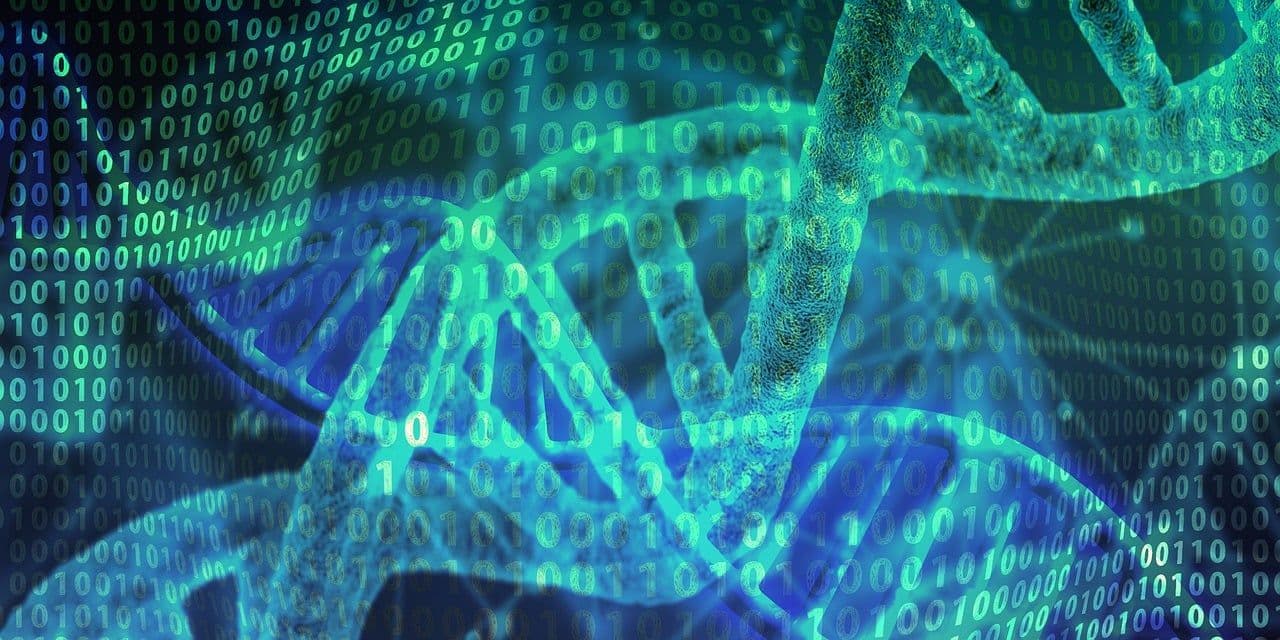
Image: Gerd Altmann (geralt) via Pixabay. Illustrative DNA helix and binary code graphic; it does not depict BioCompute's technology or experimental results.