
The boAt Apex range lists three 20,000mAh models with differences in advertised output and cable design. The official Apex series listing describes the PB400 at 22.5W with three output ports, the PB400 Pro at 22.5W, and the PB445 at 45W with triple output. This is a researched buying comparison, not a hands-on charging test. Check current prices and stock at checkout rather than treating a promotional price as permanent.
The obvious question is whether 45W is worth choosing over a lower-wattage model when the battery capacity is identical across the line. The honest answer is that it depends almost entirely on what you plug in, not on the number printed on the box.
Capacity and power solve different problems
Capacity and power answer different questions. Milliamp-hours describe nominal stored charge at the battery's specified voltage; watts describe the rate of energy transfer. The same mAh label does not establish identical usable energy or the number of full phone recharges. Check watt-hours where provided, and remember that conversion losses and device behaviour affect what reaches the phone.
Refill speed deserves a separate check. Read the input profiles for the exact model and compare them with your wall charger and cable. Do not assume that the advertised output rating is also the input rating, or that a charging label applies equally to every connector. This matters if you need to refill the bank between journeys.
Why a lower-wattage bank can still be the right pick
Phones are the clearest case. Many handsets cap their own charging rate well below 45W, and some cap it below 22.5W. When the receiving device sets the ceiling, a higher-wattage bank simply negotiates down and behaves like a slower one. You pay for headroom you never use.
Hypothetical example: a user with a mid-range phone that accepts around 18W, plus a pair of earbuds, may not gain a higher charging rate from the PB445 if both banks support the protocol that phone requires. The PB400 Pro's built-in cables could matter more in that scenario, because forgetting a cable is a far more common failure than needing extra watts.
Conversely, hypothetical example: a user who carries a compact laptop that genuinely accepts 45W over USB-C, and who needs a partial top-up during a long transit day, is the exact profile where the PB445's advertised 45W becomes the reason to choose it. The same logic applies to tablets that draw high wattage while in use.
A compatibility checklist before you choose
Work through these in order. Each one can eliminate a model faster than any spec-sheet comparison.
- Your device's accepted input. Find the maximum wattage your phone, tablet or laptop will actually accept over USB-C. A phone capped at 20W will not receive 45W simply because the bank advertises it; compatibility and other features can still differ.
- The bank's output profile. The advertised peak wattage does not guarantee that power to every connected device or every port simultaneously. Look for which port delivers which wattage.
- Protocol support. Do not assume every USB-C device or laptop accepts 45W, or that it uses the same negotiation standard. A device that does not recognise the bank's protocol may fall back to a slow charge.
- Cable rating. An unsuitable cable can prevent the expected charging rate or be inappropriate for the intended use. This is one of the cheapest mistakes to fix and one of the easiest to overlook.
- Simultaneous sharing. Triple output sounds generous, but power is typically divided when several ports are in use. If you charge three things at once, check the combined-use output limits rather than expecting the peak figure at every connection.
- Refill power. Check the input rating. A bank you cannot refill quickly is inconvenient no matter how fast it discharges.
- Weight, invoice and warranty. A 20,000mAh bank is a dense object. Confirm the weight if you carry it daily, keep the invoice for warranty claims, and read the warranty term before purchase.
Choosing between the three Apex models
On the supplied specifications alone, the split is straightforward. If your devices are phones and small accessories, the PB400's 22.5W and triple ports cover the basics, while the PB400 Pro puts emphasis on built-in cable convenience; compare its actual connectors with the devices you carry. The PB445 is the model to consider when at least one device you own genuinely accepts high wattage and you regularly need speed rather than volume.
The broader lesson mirrors what buyers face with laptops. When comparing offers, the useful discipline is matching accessory specifications to the device you already own, rather than chasing the biggest number on a listing. A discounted laptop with the wrong configuration is a poor buy; a power bank with wattage your phone cannot accept is the same mistake in miniature.
| Model | Advertised capacity | Advertised output | Notable design point |
|---|---|---|---|
| PB400 | 20,000mAh | 22.5W | Triple ports |
| PB400 Pro | 20,000mAh | 22.5W | Built-in cables |
| PB445 | 20,000mAh | 45W | Triple output |
What the specifications do not tell you
The advertised figures do not establish a tested recharge count or charging time. Real performance depends on the connected device, its charge level, cable, output profile and use of other ports. For travel, check the relevant carrier's current battery policy separately instead of assuming that an mAh label alone settles the question. This comparison does not certify the products or report independent safety testing.
This is why the decision should start with your devices rather than the product page. Write down the maximum input wattage of each item you plan to charge, note whether any of them is a laptop, and only then compare the three models. If nothing in your bag accepts more than 22.5W, the higher peak output may offer little charging-speed benefit for those devices, and the PB400 or PB400 Pro becomes the more sensible allocation of budget toward cables, ports or simply a lower outlay.
Conclusion
Within the Apex series, capacity is constant at 20,000mAh, so the real decision is power and port design. The 45W PB445 matters when you own at least one device that genuinely accepts high-wattage USB-C charging and you need speed on the move. The 22.5W PB400 and PB400 Pro suit phone-first users, with the Pro leaning on built-in cables for convenience. Check your device's accepted input, the bank's per-port output, your cable rating and the refill speed before buying, and remember that peak wattage is a ceiling rather than a guarantee.
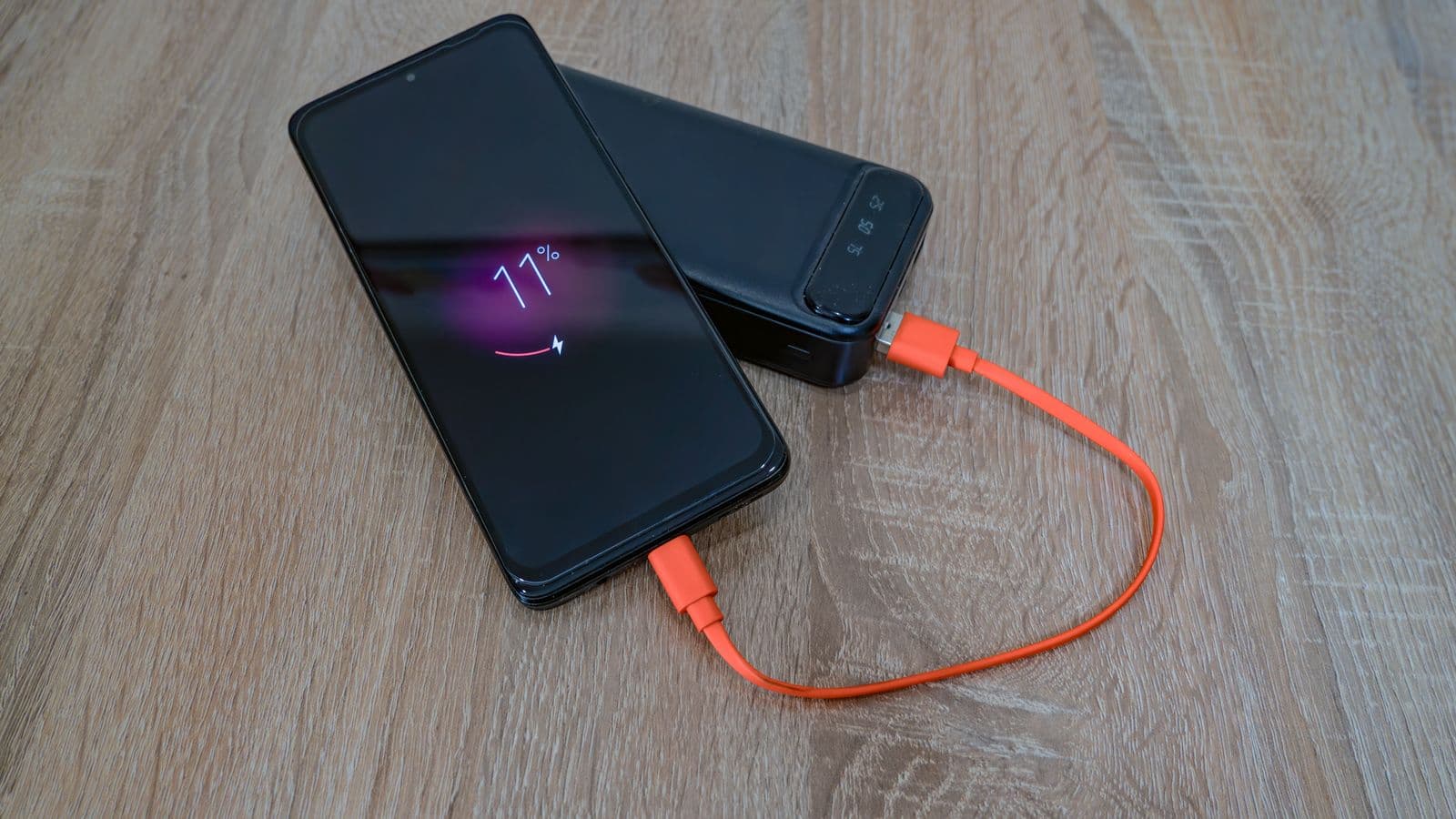
Image: Eleonora Vokueva via Pexels. Illustrative phone and portable charger; neither device is presented as a boAt Apex product.