India’s Telecom Regulatory Authority (TRAI) has expanded the designated 1601 calling series to more sectors, but the change is not an instant switch that makes every business call easy to trust. The direction issued on 27 November 2026 reserves the series for service and transactional calls by eligible, verified businesses. Telecom access providers have up to 180 days to onboard and migrate eligible entities. For consumers, the useful takeaway is simple: a 1601 caller ID can be a helpful clue when the system is rolled out, not permission to share an OTP, UPI PIN, password or card details.
What TRAI changed, and what it did not
TRAI’s second phase makes the 1601 series available to eligible companies in retail, e-commerce, hospitals, diagnostic laboratories, telecom and internet services, automobile sales and servicing, travel agencies, commercial airlines, food aggregators, ride-hailing aggregators and lending service providers. A company must meet a turnover threshold of at least ₹500 crore in one of the previous three financial years. Distribution platform operators such as DTH, HITS, IPTV and multi-system operators can qualify with at least one million subscribers in any month during the previous 12 months. The numbers are assigned only to companies registered in India.
The rule is about service and transactional voice calls, such as a delivery update or appointment coordination. Promotional calls are prohibited on the series. The direction does not say every business in these sectors is already using a 1601 number today. Access providers have 180 days from the direction to complete onboarding and migration; they must report progress to TRAI every 15 days. So there will be a transition period, and ordinary business numbers will not vanish overnight.
Use this five-step call-safety check
- Check whether the call makes sense. Were you expecting a delivery, booking, repair visit, bill update or service appointment? An unexpected call deserves extra caution, even if its number looks familiar.
- Verify inside the service you already use. Open the merchant, airline, hospital or provider app yourself and check the order, ticket or appointment. Use a saved official number or the contact details on the organisation’s genuine website. Do not use a number or link dictated by a caller who is pressuring you.
- Keep credentials private. A legitimate update should not require your UPI PIN, card CVV, net-banking password, screen-sharing access or one-time password. Never read out an OTP to “cancel” a booking or release a parcel. If payment is genuinely due, check the amount and recipient in the app before you approve it.
- Stop when the caller creates urgency. Threats of arrest, account closure, a parcel seizure or immediate penalties are reasons to pause and independently contact the organisation. Do not install an app, scan a QR code or transfer money just to keep a call going.
- Report and preserve evidence safely. Note the displayed number, time, claimed organisation and what the caller asked for. Save messages or transaction references, but do not forward identity documents or private data to strangers. Report suspected fraud through the appropriate official channel and contact your bank promptly if money or account access may be at risk.
How to interpret a 1601 caller ID
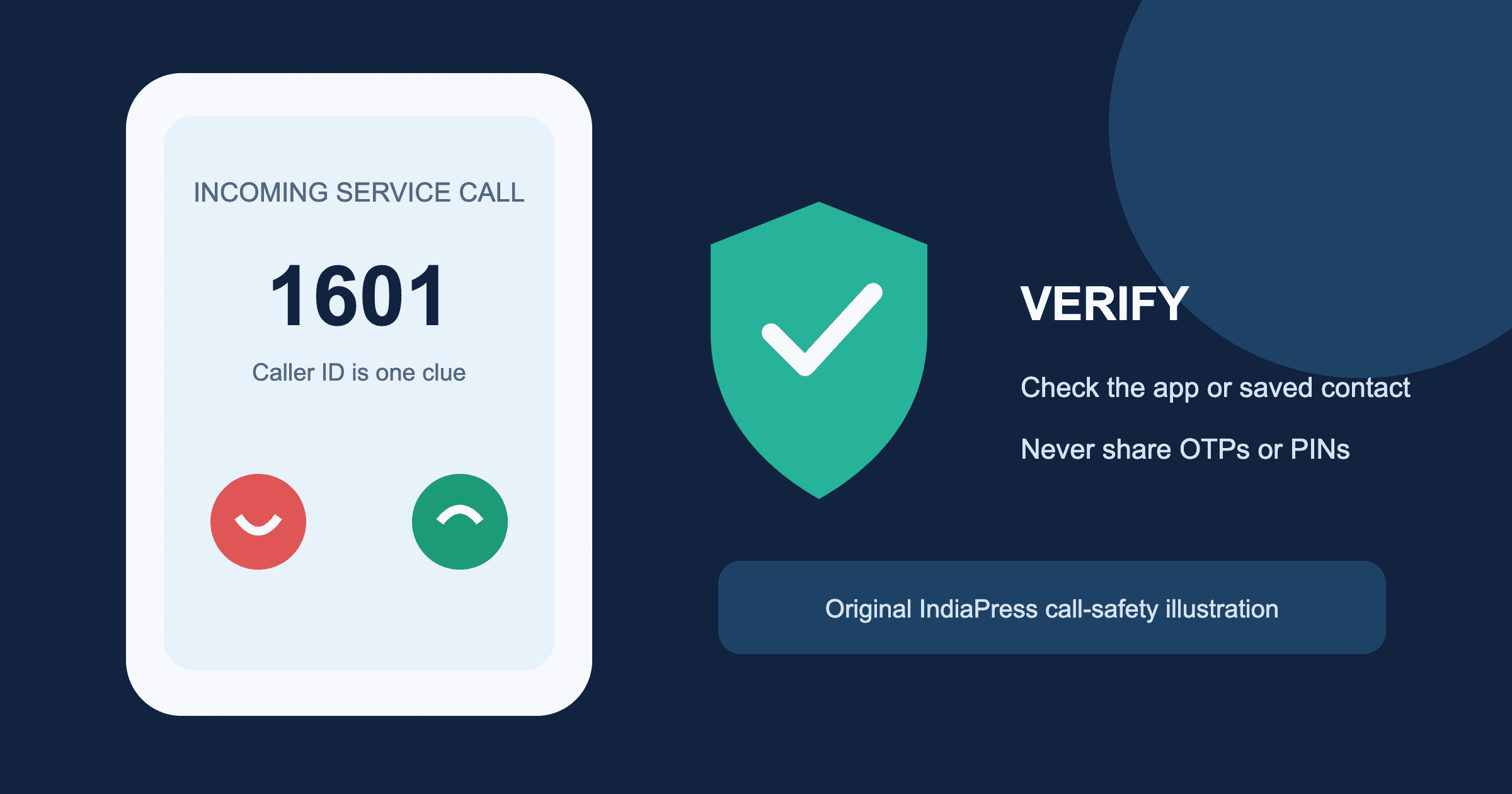
TRAI says numbers in this series are allocated to verified eligible entities and are intended to help distinguish genuine service calls from impersonation using ordinary ten-digit numbers. That improves identification, but it cannot turn caller ID into a complete security check. A display can be misunderstood, a call may be spoofed by unrelated methods, and the new onboarding will take time. Treat the number as one corroborating signal. Confirm the context through the account or contact route you initiated yourself.
Also distinguish a service call from a marketing pitch. The series is not a shortcut for a sales offer: promotional use is expressly barred under the direction. If a caller using 1601 tries to sell an unrelated product or asks for sensitive credentials, end the call and verify independently rather than assuming the series guarantees the request is safe.
For small businesses receiving service calls
If your company works in one of the listed sectors, do not assume the rule grants an immediate number. Check eligibility with your telecom access provider, confirm which company entity will hold the allocation, and ask for the documented onboarding steps. Keep appointment, delivery and payment messages aligned with the customer record so that people can verify a call from a notification they already expect. Staff should never ask customers to share authentication secrets over voice.
The 1601 change is a trust signal being introduced in phases, not a replacement for verification habits. For the policy details and covered sectors, read TRAI’s 27 November direction as reproduced by the Ministry of Communications. For the announcement, eligibility thresholds and rollout timeline in one place, see our TRAI’s official direction PDF.
This is a general consumer-safety explainer, not a guarantee that any displayed caller ID is genuine. Verify sensitive requests independently.