Voyager 1 is expected to cross a distance milestone on Wednesday, November 18: it will be one light-day from Earth. That means the spacecraft will be about 16.094 billion miles (25.902 billion kilometres) away, and a radio message travelling at the speed of light will need roughly 24 hours to reach it. The milestone is often confused with a light-year, but the two units are very different.
For readers in India, NASA’s stated crossing time of 2:16:07 a.m. Pacific Standard Time works out to about 3:46 p.m. IST on November 18. It will mark the first time a human-made object has reached this distance from Earth. The number is striking; the communication delay is what makes the distance tangible.
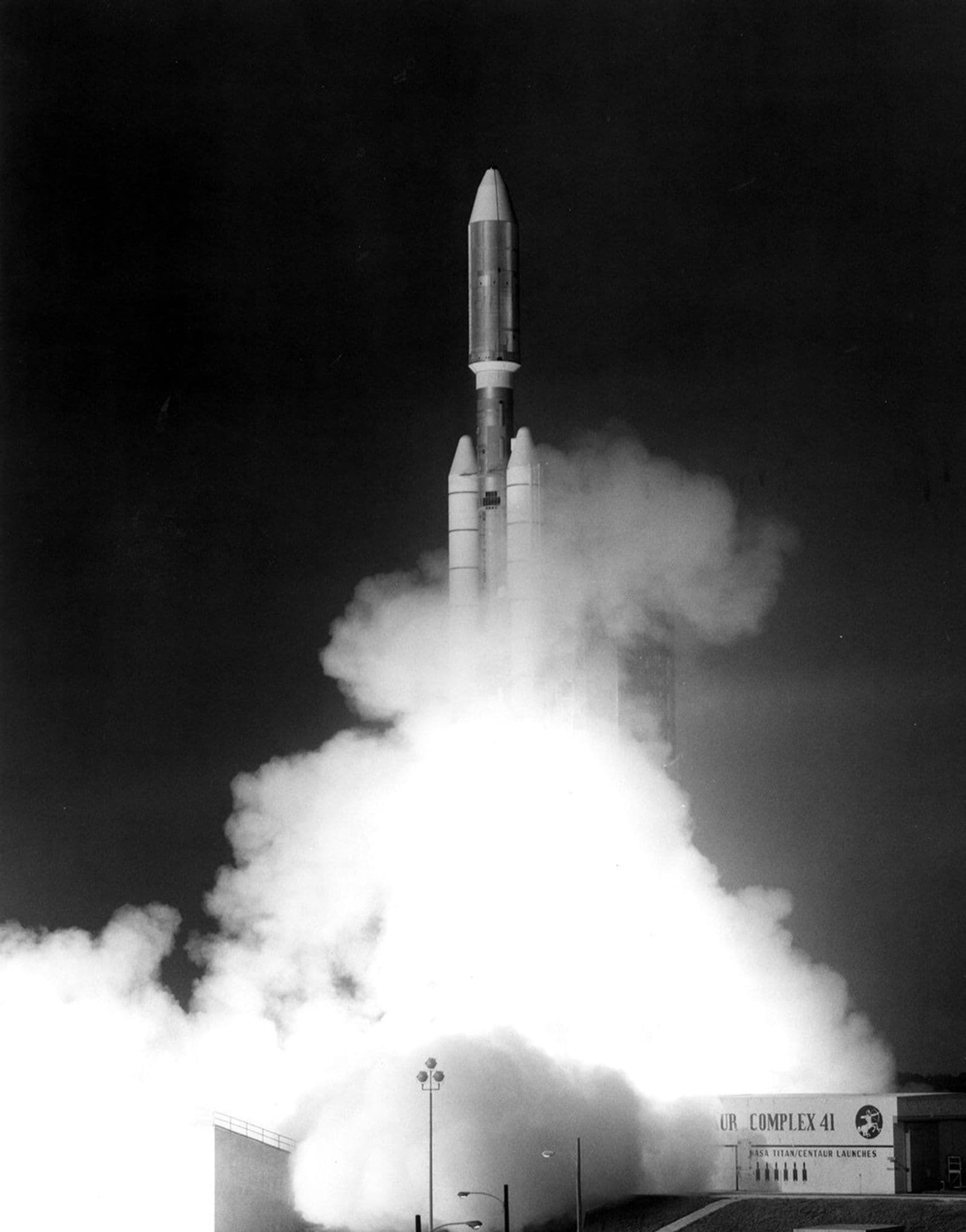
Image: NASA’s Voyager 1 spacecraft launches from Kennedy Space Center on September 5, 1977. Credit: NASA/Kennedy Space Center.
What does “one light-day” mean?
A light-day is a unit of distance, not a measure of how long Voyager 1 has been travelling. Light covers about 16.1 billion miles (25.9 billion km) in 24 hours. NASA’s projected milestone distance is 16.094 billion miles, so a signal sent from Earth will take about a day to arrive at the spacecraft.
That delay applies in both directions. A command sent from Earth takes about 24 hours to get there; a response then needs about 24 hours to return. Even a simple exchange therefore has a minimum round trip of roughly 48 hours, before accounting for the time engineers need to prepare commands, schedule antenna time or interpret data. NASA project manager Suzanne Dodd has described it plainly: send a message, then wait about two days for the reply.
A light-year is much larger: it is the distance light travels in a full year, roughly 365 light-days. Voyager 1 is not about to reach a light-year from Earth. The November event is a one-light-day milestone.
When will Voyager 1 reach the milestone?
NASA lists the crossing for 2:16:07 a.m. PST on November 18, 2026. That is 10:16:07 UTC and 3:46:07 p.m. in India. These times are a predicted distance crossing, rather than a dramatic event the spacecraft can sense. NASA says nothing will suddenly change onboard when Voyager passes the mark; its importance is that it gives people a clear measure of the enormous gap between Earth and the probe.
Voyager 1 is travelling at around 38,000 miles per hour (61,155 km/h), according to NASA’s Jet Propulsion Laboratory. Despite that speed, the spacecraft has taken nearly 50 years to reach this distance. Its journey began with a launch from Cape Canaveral, Florida, on September 5, 1977, followed by close encounters with Jupiter and Saturn before it continued outward.
Where is Voyager 1 travelling now?
Voyager 1 crossed the heliopause in 2012 and entered interstellar space. The heliopause is the outer boundary of the heliosphere, the vast region shaped by particles and magnetic fields flowing from the Sun. Crossing it is a major scientific milestone, but it does not mean the probe has reached another star or crossed the entire gravitationally defined Solar System.
Explore it in 3D: View Voyager 1 in Our Solar System with NASA Eyes to see the spacecraft’s position in NASA’s interactive Solar System visualization.
The spacecraft still collects limited measurements from its environment. NASA’s current instrument-status table lists its magnetometer and plasma-wave instrument as operating; several other instruments have been turned off over the decades to conserve power or because of degraded performance. Its cameras were switched off in 1990, so it is not sending new photographs of the places it is passing now.
That distinction matters when old Voyager images circulate online. The famous “Pale Blue Dot” view of Earth was taken in 1990, long before the spacecraft entered interstellar space. Images used to illustrate today’s milestone are archival launch or spacecraft images, not live views from Voyager 1.
How is the probe still communicating after nearly five decades?
Voyager 1 sends a faint radio signal that NASA receives through the Deep Space Network, a global system of large antennas. In October 2026, NASA’s Jet Propulsion Laboratory reported a brief communications interruption: the network did not detect the spacecraft’s signal during two scheduled attempts, but contact returned about a day later. Engineers said they were investigating the cause and had maintained communication after the signal reappeared.
Keeping the mission alive also means managing a shrinking power supply. Voyager’s radioisotope power generators produce less electricity as their plutonium fuel decays, and JPL says the probes lose about four watts of power each year. In September, engineers completed a power-saving effort on Voyager 1 by switching off three devices and using lower-power alternatives. The changes are intended to let remaining science instruments continue for longer.
This is a careful balancing act, not a guarantee that every system will keep working indefinitely. Mission engineers have to decide which measurements are most valuable, turn off equipment when necessary and account for the long delay before they can see the result of a command.
What the one-light-day mark tells us
The milestone makes deep-space distance easier to picture. The Moon is about 1.3 light-seconds from Earth; the Sun is about eight light-minutes away. Voyager 1’s signal will take a full day to cross the gap one way. For a mission team, that means troubleshooting is necessarily patient: a command and its confirmation cannot be exchanged in a quick back-and-forth.
For India-based readers following the event, the key facts are straightforward: the crossing is expected on November 18, at about 3:46 p.m. IST; the distance is approximately 16.094 billion miles (25.902 billion km); and radio communication takes about 24 hours each way. The spacecraft will not suddenly accelerate or change course at the milestone, and “one light-day” should not be read as “one light-year.”
Conclusion
Voyager 1’s one-light-day crossing is a record of distance and endurance. Launched in 1977, it has travelled beyond the Sun’s heliosphere and continues to return a limited stream of science data, despite declining power and a communication delay measured in days for a full exchange. The next time a headline says the spacecraft is one light-day away, the practical meaning is simple: a message takes roughly a day to reach Voyager and another day for a reply to get back.
NASA’s Voyager distance and instrument-status page gives the projected crossing time and current instrument list. NASA’s Jet Propulsion Laboratory explains the one-way signal delay, recent communication pause and power-saving work.